
Political Influences

The Obi–Kwankwaso Movement
& The Political Ideas That Influenced Me
A politics of competence, accountability and service
This page sets out the political ideas (associated with Peter Obi, Rabiu Kwankwaso and the wider Obidient movement) that have influenced Nonso's own philosophy of competence, accountability and egalitarian, enterprise-friendly government.
A Politics of Competence, Accountability and Service
My political thinking has been significantly influenced by the ideas and political culture associated with Peter Obi and the OK movement.
For me, the significance of the movement goes beyond an individual election. It represents a generation of Nigerians demanding a different standard of political leadership, one centred on competence, accountability, responsible management of public resources, productivity and the belief that government should be judged by the results it produces.
One of the ideas associated with Peter Obi that particularly resonates with my own political philosophy is:
“We want to build a country where the son of nobody can become somebody without knowing anybody.”
That principle captures an important idea about an egalitarian society: opportunity should not depend on family connections, political patronage or knowing the right people.
A young person should be able to succeed because of their ability, discipline, education, enterprise and character. That principle is central to how I think about the future of Nnewi South and Anambra.
The Five Cs
A framework frequently associated with Peter Obi's political philosophy is the Five Cs: Character, Competence, Capacity, Credibility and Compassion. I regard these principles as useful standards for thinking about public leadership.
Character
Public office is ultimately a question of trust. A leader controls public resources and makes decisions that affect millions of people. Character therefore matters because institutions become weaker when personal interest consistently takes precedence over public interest.
For me, character means understanding that public office is a responsibility rather than a personal entitlement. It means being prepared to make difficult decisions, accept scrutiny and place the public interest above private gain. An egalitarian society cannot be built by leaders who believe government exists primarily for themselves and their associates.
Competence
Good intentions are not enough. Government involves complex questions of infrastructure, healthcare, education, finance, economic development, regulation and public administration. A leader therefore needs the ability to understand problems, evaluate evidence, work with experts and turn ideas into workable programmes.
This principle strongly influences how I approach politics. I believe political leadership should increasingly resemble serious problem-solving. Before announcing a project, we should ask:
- What problem are we solving?
- How much will it cost?
- Who will benefit?
- How will it be financed?
- Who will implement it?
- How will we measure whether it worked?
That is the difference between an aspiration and a development programme.
Capacity
Competence is understanding what needs to be done. Capacity is having the organisational ability to actually do it. A government may have excellent policies but lack the institutions, personnel, financing and management systems necessary to implement them.
For Anambra, this distinction is particularly important. If we want reliable healthcare, we need functioning institutions. If we want better infrastructure, we need project-development capacity. If we want technical education, we need partnerships with employers and training institutions. If we want a technology economy, we need infrastructure, talent, capital and appropriate regulation. Politics must therefore be connected to implementation.
Credibility
Citizens should be able to believe what their government tells them. Credibility is built over time through consistency between:
What is promised → what is funded → what is implemented → what is delivered.
It also requires acknowledging limitations. Not every problem can be solved immediately. Not every project can be funded at once. Responsible government should therefore establish priorities, publish realistic targets and report honestly on progress. For me, credibility means that public leadership should become increasingly measurable.
Compassion
Economic development should ultimately improve human lives. A government can report impressive economic statistics while ordinary families continue to struggle with healthcare, education, housing, transportation and employment.
Compassion means remembering the human being behind every policy. It means asking how a policy affects:
- The worker
- The farmer
- The trader
- The apprentice
- The young graduate
- The elderly person
- The woman running a household
- The person living with a disability
- The family trying to access healthcare
Economic policy should therefore combine productivity with human dignity.
Why the Obidient Movement Matters to My Political Thinking
The Obidient movement demonstrated the extent to which political participation can extend beyond traditional party structures. It brought together Nigerians, particularly many young people, around concerns about governance, public accountability, economic management and the future of the country.
Its importance to me is not simply electoral. It represents a broader question:
What should Nigerians expect from their government?
Should political participation be based primarily on patronage and political connections? Or should citizens demand measurable performance, competence and accountability? That question is directly relevant to state and constituency politics.
The principles that people demand from a president should also apply to governors, legislators, local officials and community representatives. Good governance cannot begin at the presidential level and end at the constituency level. It has to exist everywhere.
From National Ideas to Local Government
One of the lessons I take from the movement is that large national aspirations ultimately have to become practical local programmes. For me, that means asking what these principles look like in Nnewi South.
- Competence means developing serious economic and infrastructure plans.
- Capacity means building partnerships and institutions capable of implementing them.
- Credibility means publishing commitments and measuring delivery.
- Character means treating public resources as a public trust.
- Compassion means designing policies around the real circumstances of ordinary people.
This is how national political ideas become local development.
An Economy Where the Son of Nobody Can Become Somebody
The idea that the “son of nobody” should be able to become “somebody” without knowing “anybody” speaks directly to my belief in an egalitarian society.
I do not believe equality means that everybody must end up with exactly the same income or occupation. I believe equality means that people should have a fair opportunity to develop their abilities.
- A child should not need a powerful surname to receive a good education.
- An entrepreneur should not need a political connection to build a business.
- An apprentice should not need a politician to find a pathway into a skilled profession.
- A farmer should not need connections to access productive infrastructure.
- A young person should not need political sponsorship to participate in the digital economy.
That is the kind of equality of opportunity I want to see strengthened in Anambra.
What I Take Forward
The Obidient movement is one influence among the ideas that have shaped my political thinking. From it, I take seriously the importance of:
- Competent government
- Responsible management of public resources
- Accountability
- Human capital
- Productivity
- Evidence-based decision-making
- The belief that Nigerian politics should aspire to a higher standard of public service
I combine those ideas with my own belief in markets, entrepreneurship, strong public institutions, redistribution of opportunity and regional economic empowerment. The result is a political philosophy that seeks to combine economic dynamism with social justice.
Government should create the conditions for people to prosper. Businesses should be free to build and compete. Workers should have dignity and opportunity. Communities should have a stronger voice in their development. And public institutions should be strong enough to deliver the foundations upon which private enterprise and individual initiative can flourish.
The standard remains simple
Character. Competence. Capacity. Credibility. Compassion.
Those are not merely qualities for one politician. They are standards by which Nigerians should judge anyone asking to serve in public office.
Movement Gallery
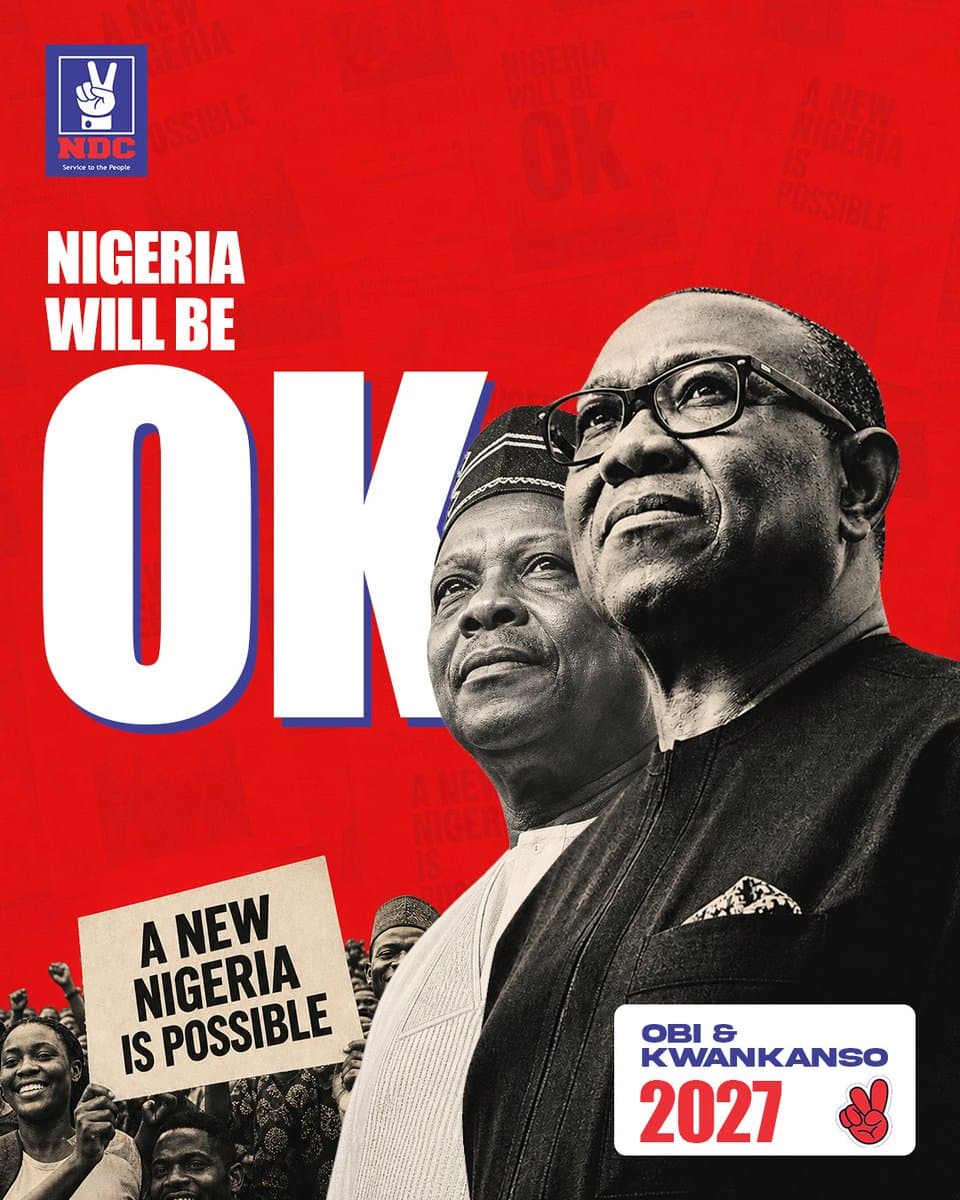
Campaign material from the wider Obi–Kwankwaso 2027 movement and the Nigeria Democratic Congress (NDC), Nonso's party.


This page describes political ideas and figures that have influenced Nonso's own philosophy. It does not claim a formal endorsement of Nonso's candidacy by Peter Obi, Rabiu Kwankwaso or any national movement.